LATEST ENTRY

CREATIVITY | Noah Brier

The Brainstorming "M Curve"

Real innovation may just be on the other side of that "idea block" you're suffering.

December 21, 2005 | RSS | EMAIL | PRINT | 10 COMMENTS

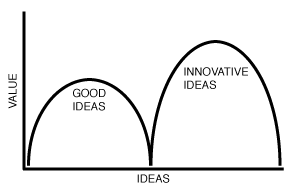
For anyone who has ever been involved in a brainstorm, or just been trying to figure out a problem, you know about how there's always that low point. It's normally the time when everyone has come up with a bunch of good ideas and it doesn't seem like there are many other interesting places to go. Often brainstorms even end at this point. However, as I learned while having a drink with a friend of mine currently getting his MBA, if you push through that valley of ideas you will see another, even more fruitful peak. That's when the really great ideas come out. The innovative ideas.

Let me illustrate for you:
mcurve.gif

Essentially what you get in that first curve is some good ideas. Sometimes they can even be great. But if you push through the low point, you have a chance to come up with even more innovative approaches to solving the problem at hand.

As someone who is quite fond of brainstorming, I'm always looking for new tips and techniques to help make ideation more fruitful. The "m curve" seems like something you can take far beyond a brainstorm, however. There's a larger lesson here about the benefits of sticking with something. Funny enough, just today I was reading an article about the importance of grit in someone's success. The article points to a recent University of Pennsylvania study, which found "that the gritty are more likely to achieve success in school, work and other pursuits -- perhaps because their passion and commitment help them endure the inevitable setbacks that occur in any long-term undertaking."

In an effort not to sound like some kind of self-help preacher, I'm going to cut myself off here. You always hear that innovative ideas come at the most unexpected times, but maybe if we just fought a little harder through our "idea block" we'd find innovation more easily.

Just as a last note, I found very little (other than this blog entry) on the "m curve" in a very limited Google search. If anyone finds any more information on it, I'd be greatly appreciative.

PREVIOUS ENTRY | NEXT ENTRY

LEAVE A COMMENT

First name, first and last, whatever you feel like.

Required, but not displayed (so don't worry about spam).

If you've got one, flaunt it.

You can use some HTML (a's, br's, p's, oh my!) if you'd like, if you don't know what that means, don't worry about it.

REMEMBER ME?

COMMENTS

1Michael Bayler

Interesting. The Socratic notion of the Elenchus is worth a look here ... In my experience the most useful insights follow directly, but the team needs to hang in and not panic during this creative lull.

December 21, 2005

2Andrew Teman

That looks like boobs.

December 21, 2005

3Noah Brier

I was wondering if someone might say that. Should have figured it was the guy with the word "clownfart" plastered all over his website. :)

December 21, 2005

4jeff

The fact that a word like "ideation" needs to exist when the word "thinking" has been doing the job quite well for some time makes me physically ill.

Also, my third grade teacher had a much easier way of posting this convoluted nonsense: keep trying. You can't dress up steak-ums like filet mignon and charge me 29.99, Noah Brier. This is simply a really complicated way of saying something really simple:

practice makes perfect.

God...

December 22, 2005

5Noah Brier

Way to go Jeff.

As for ideation, the act of thinking is a general term. You can think about anything anytime, without any necessary goal. Ideation speaks to a very specific kind of thinking. You call yourself a playwright, but that's just a specific form of writing.

As for the grit thing, yeah, everyone's mom has said practice makes perfect, and no one really believed them. Most people feel like you either have the talent or you don't: you're gifted or you're not. This is research showing that talent may be the least important part of success. That's a bigger deal than a cliche.

Sorry you missed that.

December 22, 2005

6Noah Brier

Also, as I think more about your comment. The M-Curve has nothing to do with practice. It's not about getting better at something, it's about solving a problem and working through the difficulities. Practice is about doing something often in order to get better at it, this is about breaking through barriers that you face on an individual problem. Again, going back to writing, you practice writing to become a better writer generally. The M-Curve, on the other hand, is about fighting through your writers block, for example, because the best ideas exist on the other side of it.

December 22, 2005

7Diamond

There are two major factors in a brainstorming that need to be discussed before establishing the "bad bood job" curve.

Groupthink occurs when groups are highly cohesive and when they are under considerable pressure to make a quality decision.

An extension of group think is the The Abilene Paradox. This is a paradox in which the limits of a particular situation force a group of people to act in a way that is directly the opposite of their actual preferences. It is a phenomenon that occurs when groups continue with misguided activities which no group member desires because no member is willing to raise objections.

In my experience the brainstorm is only successful when you strip ego and the power of its participants from the session. The environment must allow all participants to have equal voice. The curve does not compare actual results to potential outcome.

December 22, 2005

8jeff

you can't hide.

December 22, 2005

9jeff

my problem with the m curve is it feels and reads like an incredibly arbitrary and un-based theory. it's a scientific principle without the use of science.

December 26, 2005

10Noah Brier

There may be some science behind it, unfortunately as I mentioned I had a great deal of difficulty finding more information on it, however. Obviously it's not absolute, but from my own experiences it's right on. From my experience, it's spot on. There normally a lull and when you break past that you often find the most fruitful ideas. Often that lull happens when you exhaust the obvious possibilities. Once you've thrown all those out on the table it's hard to do anything but think of different kinds of ideas. Check out this post on the verifier approach, which puts some science behind innovation. Often the biggest innovators solve problems outside their discipline. They have a different take on a problem, which allows them to explore new directions. The verifier approach involves three steps: "watching how they work and think, testing their logic, and uncovering ways to help them solve problems." Before the larger breakthrough (the second part of the m curve, if you will), you have to go through the grunt work, looking at as many possible explanations as possible in order to identify the holes (the first part of the m curve).

Many people never make it through the obvious answers. Whether there's science behind it or not, who cares? (Though I do assume there's research behind the m curve.)

December 27, 2005